⚖️ Transforming the Legal Bottleneck: Why the Enterprise Needs Sovereign, Agentic Contract Lifecycle Management
How multi-agent RAG architectures, local PII redaction, and Human-in-the-Loop interlocks turn weeks of contract friction into hours of governed commercial velocity.
In almost every modern enterprise, a silent crisis unfolds between closing a deal and recognizing its revenue. A top-tier enterprise sales team negotiates terms with a new Fortune 500 client in record time, only for the Master Services Agreement (MSA) or SaaS contract to sit trapped in the legal queue for 3 to 8 weeks.
During this period, commercial momentum grinds to a halt. In-house counsels and procurement teams are overwhelmed by hundreds of pages of complex, non-standard clauses, including indemnity caps, intellectual property assignments, automatic rollover renewals, and data protection terms. Each review involves manual document cross-referencing, multi-thread redlining across disconnected email chains, and anxious cross-border compliance audits.
"Contracts are the legal and commercial DNA of the modern enterprise. Yet, while engineering, sales, and marketing have undergone exponential digital acceleration, contract management remains largely frozen in manual, high-friction review cycles."
When generative AI exploded, the immediate instinct was to paste contract PDFs into generic LLM chat windows. But inside an enterprise governed by SOC 2, HIPAA, and GDPR, doing so is catastrophic: pasting proprietary commercial agreements into third-party, public model endpoints leaks non-public financial terms, violates geographic data residency boundaries, and trains external AI models on confidential corporate IP.
This reality inspired the creation of Aegis CLM, a zero-trust, sovereign, multi-agent contract lifecycle platform engineered specifically to solve the tension between uncompromised legal security and enterprise velocity.
Why Now? The Cost of Legal Friction
The business cost of contract inertia is staggering. Studies consistently show that inefficient contract processes can cost organizations between 5% to 9% of total annual revenue through deal slippage, missed renewal renegotiation windows, and unmanaged post-signature obligations.
Furthermore, multinational corporations face cross-border linguistic and regulatory complexity. In bilingual and international environments (e.g., Canadian, European, and global markets), contracts frequently transition between English and French. Traditional software solutions handle this through slow, third-party translation bureaus, introducing further delay and translation drift.
What General Counsels, CFOs, and CROs need is not another passive PDF repository. They need an active, cognitive intelligence layer that acts as an autonomous legal copilot, accelerating every stage of the lifecycle while preserving strict human authority and enterprise compliance.
From - To: The Paradigm Shift in Contract Lifecycle Management
To grasp the magnitude of value unlocked by an agentic CLM architecture, consider the contrast between legacy workflows and Aegis CLM:
| Lifecycle Dimension | Traditional Legacy CLM | Aegis Agentic CLM |
|---|---|---|
| Triage & Ingestion | Manual scanning, PDF OCR errors, 3–5 days to log metadata and parties. | Autonomous Ingestion Agent: Bilingual parsing (EN/FR) & local zero-trust PII sanitization in <10 seconds. |
| Risk Analysis | Manual line-by-line review against static PDF guidelines; high risk of oversight. | Vector RAG Playbook: Instant semantic comparison against corporate policies; multi-tier risk highlighting (High/Med/Low). |
| Redlining & Negotiation | Fragmented email exchanges, manual redline drafting, multi-week turnaround. | Negotiation Agent: Instant contextual counter-clause drafting in target language with legal justification. |
| Post-Signature Tracking | Forgotten in cloud drives; reactive firefighting when SLAs or renewal windows lapse. | Obligations Agent: Automatic extraction of deliverables, calendar deadlines, and SLA verification targets. |
| Security & Sovereignty | Blind API calls or public LLMs exposing sensitive data to model training. | Zero-Trust Gateway: Sovereign data residency pins, absolute model training opt-outs, and immutable SOC 2 audit logs. |
The 4-Stage Agentic Architecture in Action
Rather than relying on a fragile, monolithic "one-shot" prompt, Aegis CLM decomposes the contract lifecycle into a choreographed pipeline of four specialized autonomous agents, supported by an executive governance hub:
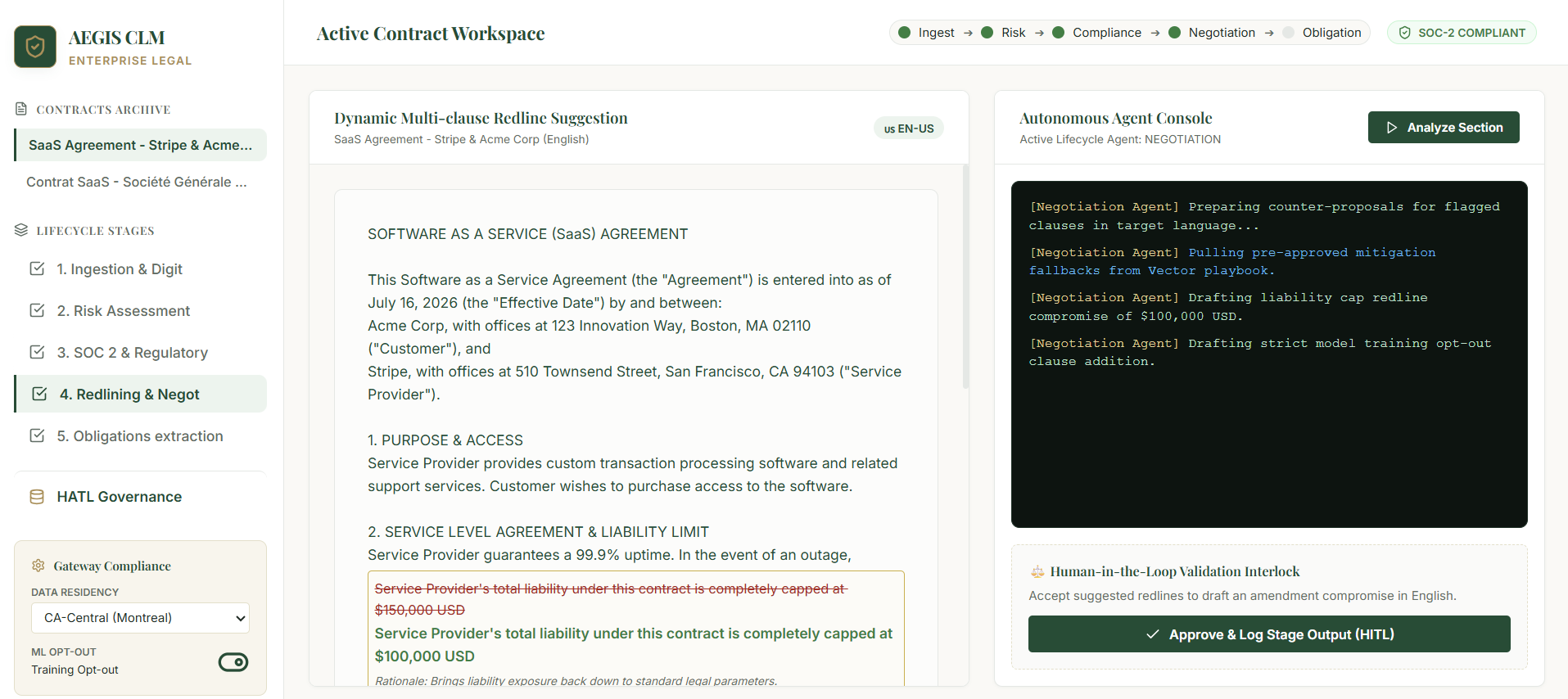
1. Ingestion & Digitization Agent
The journey begins the moment a raw contract payload is received. The Ingestion Agent detects document language (English or French), validates structural tokens, and executes a Zero-Trust PII Redactor locally in memory.
Before any external gateway handshake occurs, sensitive customer identifiers, banking routing codes, and financial metadata are masked into safe deterministic tokens, ensuring absolute confidentiality.
2. Playbook Risk Assessment Agent
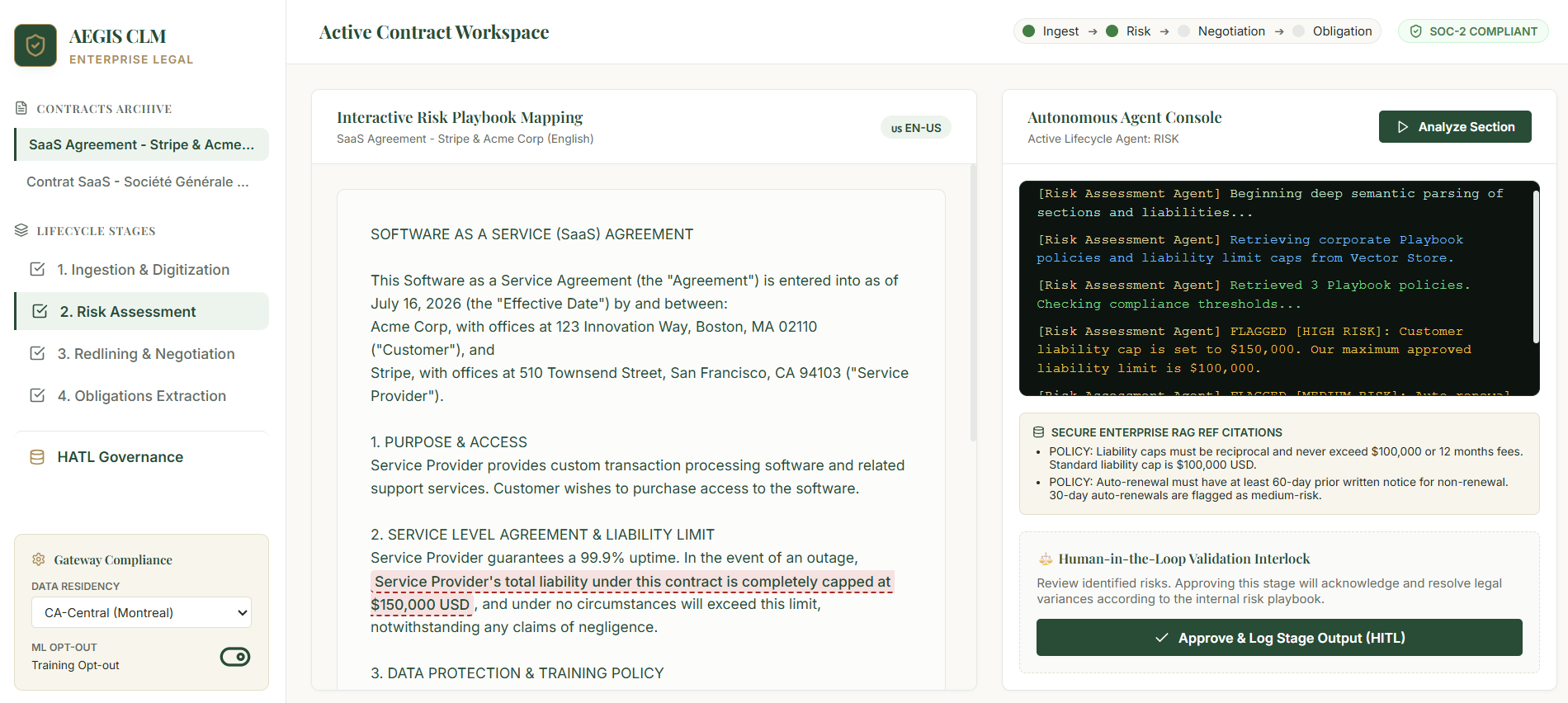
Once structured, the contract is evaluated against the enterprise corporate legal playbook using an Enterprise RAG Vector Gateway. The Risk Assessment Agent semantically compares liability limits, indemnity commitments, governing jurisdictions, and auto-renewal triggers against pre-approved corporate standards.
High-risk clauses (such as un-capped liabilities or aggressive lock-in renewals) are highlighted in real time directly on the interactive document canvas.
3. Redlining & Negotiation Agent
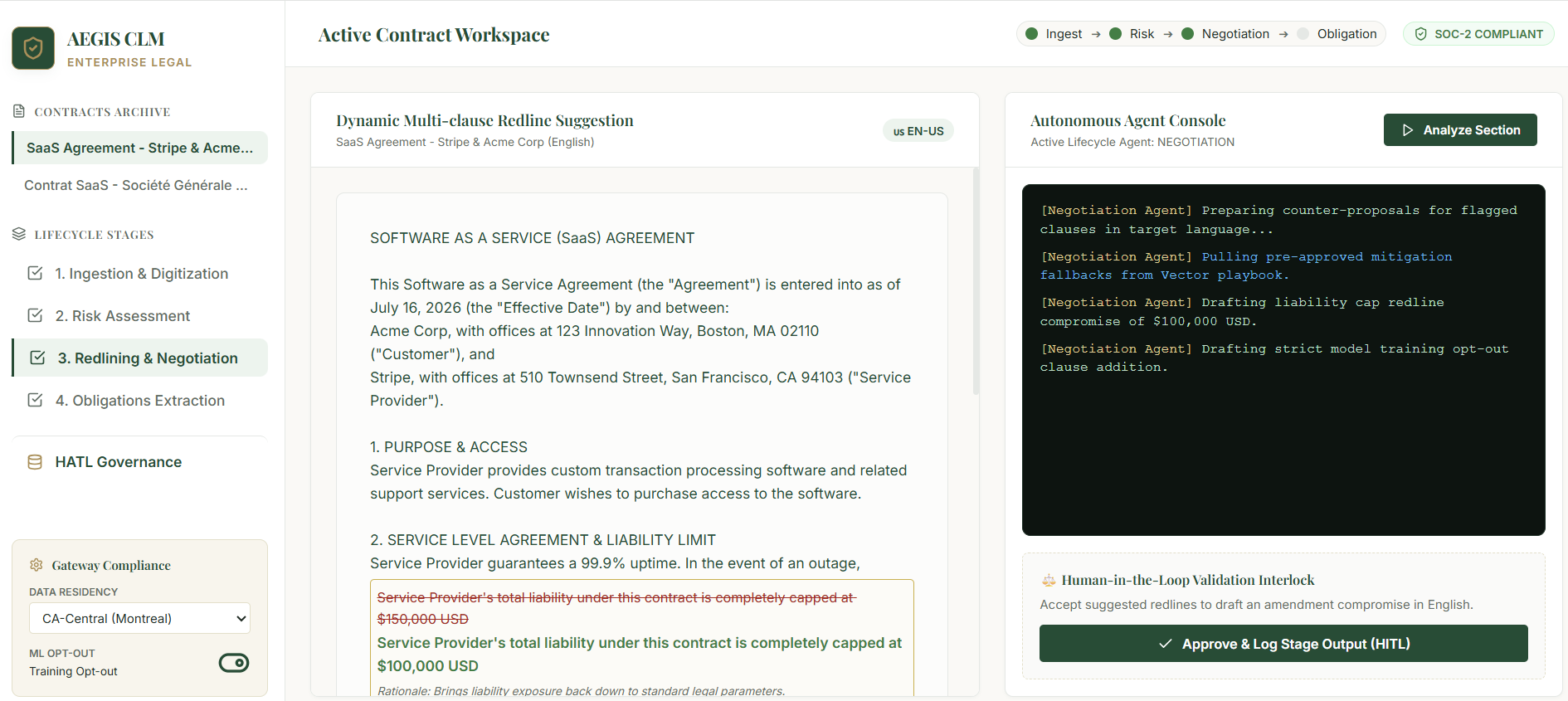
Identifying risk is only half the battle; closing the deal requires constructive compromise. The Negotiation Agent pulls vetted fallback provisions from the vector playbook and drafts balanced, legally precise counter-proposals in the contract native language.
The document viewer renders a clear split-screen diff showing original phrasing alongside proposed compromise text, complete with legal justification annotations.
4. Post-Signature Obligations Extraction Agent
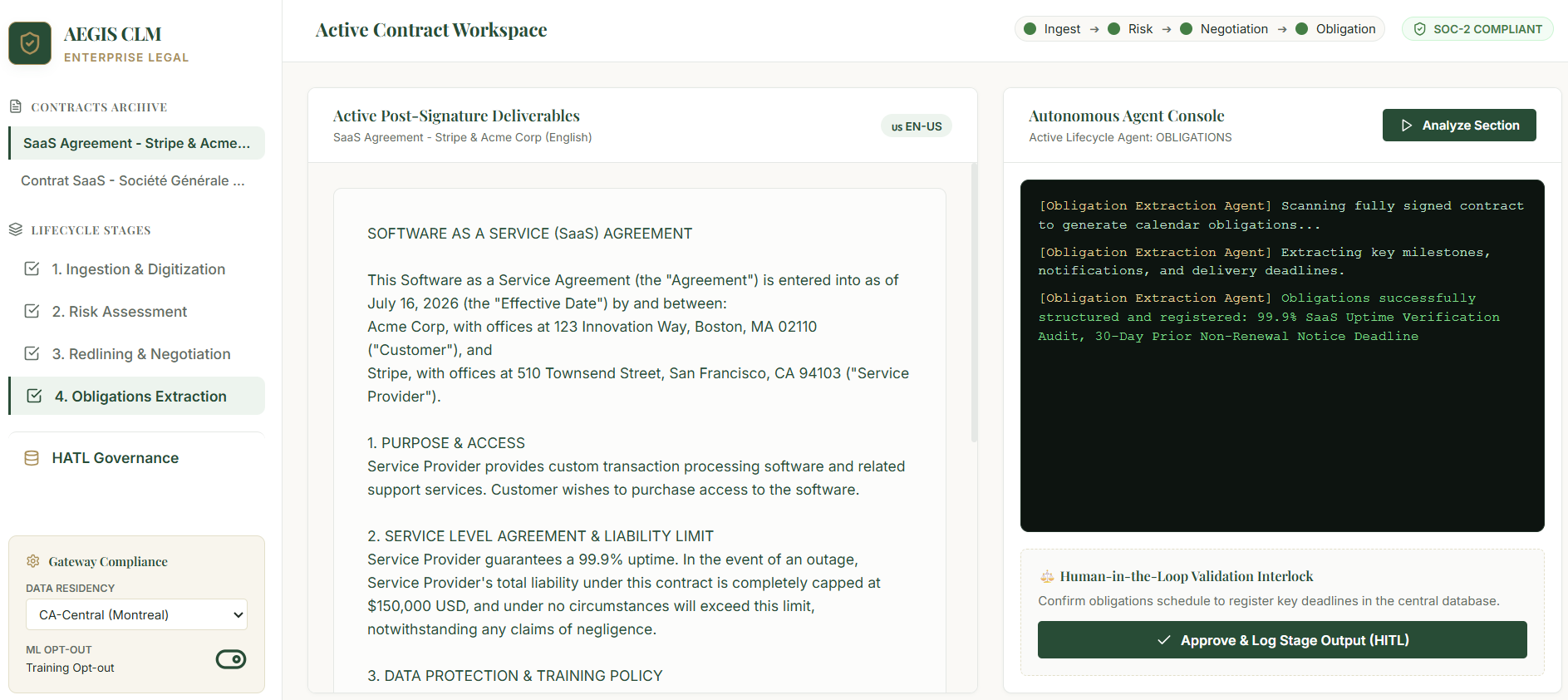
Once an agreement is executed, value realization depends on operational compliance. The Obligations Agent parses the finalized agreement to construct a structured operational calendar, extracting SLA uptime commitments, notice period deadlines, audit windows, and milestone deliverable dates.
Governance by Design: Dual-Layer Human Oversight (HITL + HATL)
Uncontrolled autonomy in legal technology is unacceptable. A single hallucinated liability cap or overlooked indemnity waiver can expose an enterprise to catastrophic risk. To deliver unshakeable trust, Aegis CLM establishes a rigorous Dual-Layer Governance Model:
Layer 1: Human-in-the-Loop (HITL) Stepping Interlocks
The agent pipeline never executes as an unmonitored runaway loop. Instead, the architecture incorporates formal HITL Stepping Gates. After each agent completes its analysis, the pipeline halts.
The legal counsel reviews the extracted metadata, approves or adjusts risk scores, and inspects proposed redlines directly in the console before manually clicking "Approve & Log Stage Output". Only human authorization transitions the workspace to the subsequent stage.
Layer 2: Human-above-the-Loop (HATL) Executive Oversight
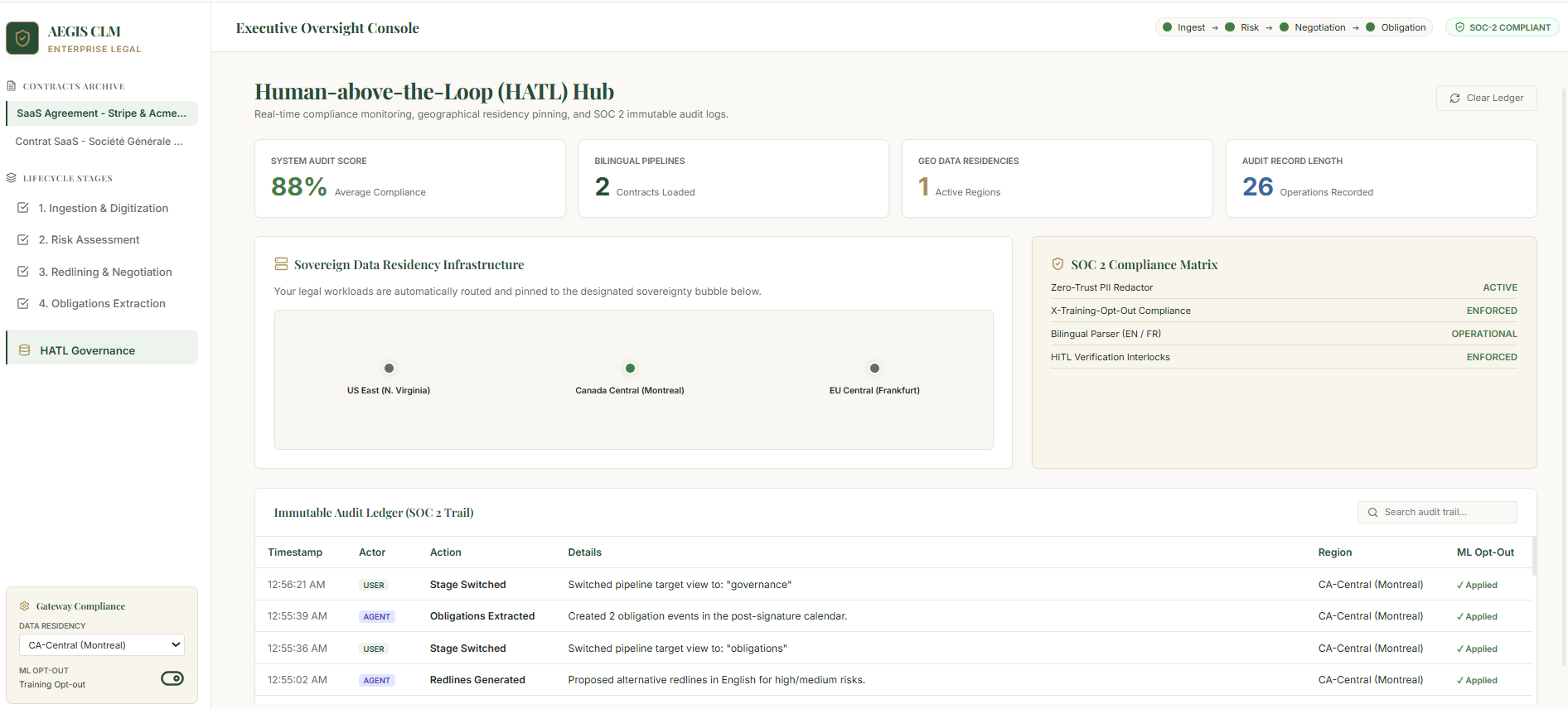
Beyond individual contract interactions, enterprise leaders need comprehensive operational visibility. The HATL Governance Dashboard provides a real-time command center:
- Dynamic Sovereign Data Residency: Pinned regional routing (e.g.,
CA-Central (Montreal),US-East,EU-Central) ensuring no payload crosses unauthorized jurisdictional borders. - Absolute Model Training Opt-Out: Mandatory
X-Training-Opt-Out: trueenforcement headers across all RAG and LLM gateway calls. - Immutable SOC 2 Compliance Audit Ledger: A real-time, searchable event ledger recording every user edit, agent thought, PII redaction, and stage transition for seamless compliance auditing.
⚙️ Under the Hood: Technical Architecture & Engineering Choices
For the engineering and AI architecture leaders evaluating this design, building an enterprise-grade agentic legal platform required solving hard constraints around latency, determinism, bilingual semantic fidelity, and cryptographic auditability.
AgentPipelineService) rather than unconstrained, stochastic agentic loops. This guarantees that contract state transitions are 100% deterministic and testable.piiRedactor.ts) executing entirely in client/edge memory. Entities (banking IBANs, SSNs, credit terms) are mapped to deterministic tokens before any payload hits API serialization.mockGateway.ts) that injects SOC 2 compliance headers (X-Data-Residency, X-Training-Opt-Out) and rate-limiting throttling.storage.ts) tracking agent reasoning tokens, prompt hashes, execution latencies, and explicit user override timestamps for continuous compliance review.1. RAG & Embedding Strategy: The Trade-Off Space
When selecting the retrieval and embedding strategy for enterprise legal contracts, off-the-shelf naive RAG implementations fail. In legal agreements, a single missed word (e.g., "shall" vs. "may") or a cross-reference like "subject to Section 14.2(b)" completely alters commercial liability.
We evaluated three primary RAG architectures before settling on our production strategy:
| Architecture | Technical Limitations | Enterprise Fit & Evaluation |
|---|---|---|
| Dense-Only Embeddings (e.g., Ada-002, BGE) |
High semantic recall but severely struggles with precise legal terms of art, exact section numbers, and numerical monetary thresholds. | Insufficient for Legal: Hallucinates semantic similarity between mutually exclusive indemnity conditions. |
| Sparse / Lexical Search (e.g., BM25, TF-IDF) |
Perfect for exact clause cross-references, but completely blind to bilingual paraphrasing and French-to-English conceptual equivalence. | Brittle across Languages: Fails when an English clause ("Limitation of Liability") is drafted in French ("Limitation de Responsabilité"). |
| Hybrid Dense + Lexical with Cross-Encoder Reranking (Chosen) | Requires two-stage index computation (lexical inverted index + multi-lingual dense vector store). | Production Optimal: Combines exact term-of-art keyword filtering with multilingual embedding spaces, followed by top-k cross-encoder reranking against corporate playbooks. |
2. Chunking Strategy: Why Fixed-Window Token Chunking Fails in CLM
Standard fixed-token chunking (e.g., splitting every 512 tokens with 50-token overlap) is catastrophic for legal documents. It frequently splits a liability obligation in half, placing the affirmative covenant in Chunk A and the limitation exception in Chunk B.
Aegis CLM implements Hierarchical Clause-Semantic Chunking:
// Pseudocode of Aegis Hierarchical Clause Chunking
interface LegalClauseChunk {
  clauseId: string;              // e.g. "SEC_8_INDEMNIFICATION"
  parentArticle: string;         // e.g. "ARTICLE_8_RISK_ALLOCATION"
  heading: string;               // e.g. "8.2 Indemnification by Customer"
  body: string;                  // Full text with preserved exceptions
  crossReferences: string[];     // ["Section 8.1", "Schedule B"]
  language: 'en' | 'fr';
  piiMasked: boolean;
}
By indexing at the structural clause level rather than arbitrary token boundaries, the Risk Assessment Agent receives complete legal contexts, preserving parent-child contractual hierarchies.
3. Guardrails, Limitations & Hallucination Containment
To eliminate model hallucinations in high-stakes legal redlining, the platform enforces strict runtime guardrails:
- Temperature Clamping: The LLM gateway clamps sampling temperature between
0.0and0.2for risk and obligation extraction, prioritizing determinism over creative variation. - Strict Playbook Citation Enforcement: In Stage 3 (Redlining), the agent is programmatically forbidden from generating counter-clauses from scratch. It is required to select from pre-approved corporate fallback provisions and parameterize them to the contract context.
- Cross-Lingual Parity Assertions: When processing French agreements, the system validates that extracted legal obligations match civil code terminology (e.g., "Dommages Indirects" mapped correctly to consequential damages limits).
- Context Window Optimization: Rather than dumping 80-page contracts into a mega-context prompt (which triggers "Lost in the Middle" attention degradation), each agent stage processes only the targeted clause slices relevant to its domain.
4. Cryptographic Traceability & Telemetry
For SOC 2 Type II auditability, every execution step produces verifiable telemetry recorded in the governance ledger:
// Immutable Audit Telemetry Event Schema
interface AuditLogEvent {
  eventId: "evt_7f8a9b2c3d";
  timestamp: "2026-08-17T22:45:10.124Z";
  stage: "risk_assessment";
  actor: "agent_risk_evaluator_v1";
  dataResidencyRegion: "CA-Central";
  modelTrainingOptOut: true;
  payloadHash: "sha256:e3b0c44298fc1c149afbf4c8996fb92427ae41e4649b934ca495991b7852b855";
  piiItemsMaskedCount: 3;
  executionDurationMs: 842;
  userOverride: false;
}
Why Executives Should Care: The Strategic ROI
For executive leadership teams evaluating AI adoption, Aegis CLM delivers tangible, boardroom-level impact across four key pillars:
- Design for Trust First: Enterprise adoption does not hinge on model parameter size; it hinges on data residency, privacy guarantees, and verifiable audit trails.
- Deconstruct Monolithic Prompts into Agentic Stages: Multi-agent pipelines with dedicated responsibilities drastically outperform one-shot prompts in consistency, explainability, and error recovery.
- Elevate Human Agency: AI should not replace legal judgment; it should eliminate mechanical drudgery, freeing legal teams to focus on strategic negotiation and complex deal architecture.
Shifting the Paradigm: From Risk Paralysis to Commercial Velocity
The future of enterprise software is not about building autonomous systems that operate without human oversight. It is about building governed agentic systems where AI amplifies human expertise within secure, compliant, and transparent boundaries.
With Aegis CLM, legal teams are no longer perceived as the "department of deal slowdown." Instead, they become agile drivers of commercial velocity, protecting the enterprise with military-grade rigor while moving at the speed of modern business.